
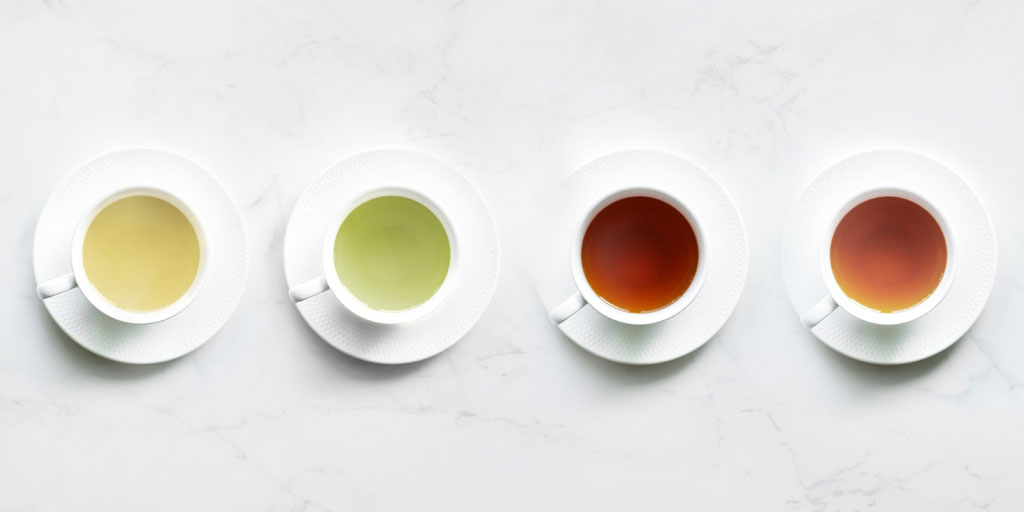
What is the difference between white tea, green tea, black tea and oolong tea? You may be surprised to learn that all four varieties actually come from the same plant, the Camellia sinensis. This plant is also called the “tea plant” or the “tea tree.” (Yes…it’s the same plant where we get antiseptic tea tree oil.) While all of these teas are made from this one plant, it’s the different preparation methods that give them their own distinct looks and flavors.
White Tea
Unlike green tea or black tea, white tea is made when the Camellia sinensis leaves are still young buds. It’s at this young stage when the leaves have silvery white hairs, from where “white tea” gets its name. Most white teas come from Fujian, China, which especially famous for its high-quality white tea.
Compared to green tea and black tea, white tea has minimal processing with only withering and drying. Such minimal processing gives white tea a higher concentration of antioxidants. While the production of white tea may sound simple, it is actually very costly and time-consuming. The tea leaves must be harvested at a very specific time and its fine white hairs must be handled very carefully. It’s because of this difficult production process that white tea is often pricier than other teas.
What does white tea taste like?
In contrast to the boldness of green tea and black tea, white tea has a lighter, sweeter flavor.
Green Tea
Green tea is also made from young leaves of the Camellia sinensis. As soon as they are picked, the leaves are dried to prevent them from fermenting. The leaves then undergo numerous steps of processing, often using special machinery, to be dried and rolled.
The exact production methods also vary depending on the region and the variation of green tea being made. For example, green tea producers in China often use a drying technique in which they pan-fire their leaves in large woks. Japan, known for its wide variety of green teas, often steams their green tea leaves, and the amount of time to steam differs depending on the variation.
What does green tea taste like?
Green tea is known for tasting light and slightly sweet and grassy.
Black Tea
Black tea is the most common tea in western countries, and is actually called red tea in China. Unlike other teas, black teas are allowed to fully oxidize, which is the reason why black tea has a darker color. There are two main production methods for black tea: the Orthodox method and the CTC (Cut/Crush, Tear, Curl) method.
With the Orthodox method, the Camellia sinensis leaves are heat withered for up to 18 hours. More pliable after drying, the leaves are rolled which then allows the tea leaves to oxidize. The leaves undergo a second round of oxidizing and are then placed in a drying machine for its final stage.
The CTC method was developed in response to the emergence of the tea bag. This method also involves drying and oxidizing like in the orthodox method. However, its main difference is that the leaves are not rolled. The leaves are instead crushed, cut, torn and curled into tiny pellets small enough to fit in a tea bag.
What does black tea taste like?
Black tea has many variations and flavors. For example, Assam tea can taste creamy and earthy, while chai tea is sweet with a hint of spice. The taste of black tea can vary widely, though it is generally considered to taste bolder than green and white tea.
Oolong Tea
Oolong tea is believed to have been created in the mid 1800s in Fujian, China. Tea farmers from this region created this new tea by combining some production methods of both green and black teas.
To create Oolong tea, fully grown shoots are picked and withered by air and sunlight. They then undergo a process in which they are tossed and rotated. This damages the edges of the leaves and causes partial oxidation, creating a reddish color on the leaf edges. To prevent full oxidation, the leaves are quickly heated at a high temperature. Following this are a number of steps to roll and dry the leaves. Because Oolong tea is partially oxidized, it’s oxidation is at a level between green and black tea.
What does oolong tea taste like?
Oolong teas can come in a wide variety of tastes. Some can taste sweet, fruity or nutty depending on the tea.
Which tea is your favorite?
Feel free to check out our tea accessories by clicking here.
REFERENCES ▾
- Time for Tea by Matthew Kadey, RD
- An Introduction to White Tea by Lindsey Goodwin
- White Tea by New World Encyclopedia
- Green Tea by Encylopedia.com
- Black Tea by Tea Spot
- An Introduction to Black Tea by Lindsey Goodwin
- All about CTC by Lindsey Goodwin
- What is Oolong Tea – A Complete Guide by Royal Tips Tea
- Oolong Tea by Science Direct
